
'It will drive a lot of surrounding business, that is where we see some good projects coming in.'

India's first $1 trillion company by market capitalisation (mcap) is achievable by 2032 and HDFC Bank and Reliance Industries (RIL) are seen as lead contenders, ICICI Securities said in a note on Monday. To achieve this, the shares of both the firms will have to appreciate at least 20 per cent annually for the next decade. ICICI Securities believes this is possible if India's gross domestic product (GDP) growth accelerates to 9 per cent per annum and corporate profitability cycle peaks. "Our calculations suggest that India's first $1 trillion mcap stock could emerge by 2032.

As Ayodhya readies itself for the glittering, much-awaited consecration ceremony of the Ram Mandir on January 22, and as millions of pilgrims and devotees pour into the holy city for the momentous event, companies are rushing to do their bit and be a part of the mega celebrations. Some are offering a part of their profits as donations, telcos are beefing up the number of cellular towers to ensure better connectivity, and there are those distributing jalebis and food platters.
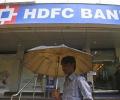
After the latest rout, the American depositary receipt (ADR) premium of HDFC Bank to its local shares has shrunk to nearly zero. Shares of HDFC Bank on Thursday fell 3.1 per cent to Rs 1,490, extending its two-day decline to 11 per cent. Meanwhile, the ADR has slumped over 15 per cent in the past two trading sessions.

Technology companies continue to be the most valued brands globally, with the top five most valued companies from the technology sector, according to Brand Finance 2024. Samsung has entered the top five most valued brands globally. Apple secured the first position after falling to the second spot in 2023.

'Two in three creators in India who earn money from YouTube agree that YouTube is their primary source of revenue.'

Trouble started brewing after Cognizant announced that Ravi Kumar, former Infosys president, would take over as the Nasdaq-listed company's CEO.

Hospital chain Aster DM Healthcare's plans to sell its Gulf business may run into rough weather with voting advisory firm Institutional Investor Advisory Services (IiAS) raising concerns over the transaction. Recommending an 'against' vote on the resolution, IiAS has said there is no clarity on how Aster DM will utilise the proceeds that it will obtain by selling the unit, which contributes to bulk of its revenues. In November, Aster DM had announced its plans to sell its wholly-owned subsidiary Affinity Holdings, which conducts business in the Gulf Cooperation Council (GCC) region, to Alpha GCC for $1 billion.

India's top technology companies will witness a tepid revenue expansion in the third quarter (October - December) of the current financial year (Q3FY24) - along expected lines - on the back of furloughs and no blockbuster deals, even as the momentum gained from Generative AI (GenAI) is likely to take centre stage. IT services and consulting firm Accenture's first quarter numbers in FY24 showed a significant pick up in GenAI spending. It signed new bookings to the tune of $450 million in this space, a surge from the $300 million signed in the whole of FY23.

Creating an LLM trained on Indian languages is not easy. Experts say each language in India has a nuance of its own, so creating a ChatGPT-like product is an ambitious challenge.

Only the top 5 per cent profit makers account for 75 per cent of profits.

Tata Consultancy Services (TCS) has to "keep evolving" and be relevant to clients as generative artificial intelligence (GenAI) technologies emerge, K Krithivasan, chief executive officer and managing director of the IT company, has said in a New Year's message to employees. "It is always heartening to see the reinforcement of how strong our relationships are with our clients and the level of trust they place with us.

Going 'long' is becoming an overcrowded trade on Dalal Street, and any negative trigger could lead to a sharp correction, warn experts. However, given the strong momentum, particularly in IT stocks, the downside could be protected in the immediate term. "With the Nifty50 surging to new life-time highs, the bulls remain in control. Further upsides are likely once the immediate resistance of 21,492 is taken out.

The gap between market capitalisation of Hong Kong and India has dwindled significantly. At present, India's market cap stands at approximately $4.3 trillion, while Hong Kong's is around $4.7 trillion. In the depths of the Covid-19 crisis in March 2020, Hong Kong's market cap, at $4.6 trillion, was 3.44 times larger than India's.

'The deal pipeline across products is robust for 2024.'

After a sharp rally in the equities market this year, investors could be better off rotating some funds towards the debt market. Experts believe several tailwinds could spur bond market returns over the next 12-18 months. These include India's robust macroeconomics, declining inflation, and the imminent passive flows of close to Rs 2.5 trillion on account of domestic sovereign bonds getting included in the JP Morgan global indices.

Global private equity (PE) firms are successfully offloading large equity stakes in domestic companies in the open market, taking advantage of buoyant conditions. Strong domestic liquidity support and an upward trending market have underpinned over a dozen PE exits worth $2.5 billion, data compiled by Business Standard shows. The figures exclude PE exits during maiden share sales and shares sold by strategic investors, such as SoftBank and Ant Group in new-age companies.

The verdict in the Google versus Epic Games antitrust case in the US has spread cheer among the Indian gaming and app developers. Ending a three-year legal battle, the San Francisco jury found that Google turned its Play app store and billing service into an illegal monopoly. American video game maker Epic Games, best known for Fortnite, had sued Google in 2020.

The National Stock Exchange (NSE) of India is going to indefinitely defer the internal deadline set for extending trading hours, according to sources in the know. The exchange aimed to introduce a three-hour evening session exclusively for index derivatives by March 2024, contingent upon regulatory clearance from the Securities and Exchange Board of India (Sebi). Sources indicate that the market regulator has not provided a favourable indication, dimming optimism surrounding the proposal.

'A key reason for the strong interest in IPOs has been an increased focus on profitability and reasonable pricing of deals.'
 © 2026 Rediff.com - Investor Information - Advertise with us - Disclaimer - Privacy Policy - Sitemap - Feedback - About us - Terms of use - Grievances